Field manual · An elegant weapon
Lightsabers
A blade of pure energy, a living crystal at its heart and a hilt every Jedi builds by hand. Take one apart, find out why Sith blades are red, try every color and shape — and hear how a cinema projector and a TV set made the most famous sound in film.
Move the pointer over the blade to swing it
- First on screen
- A New Hope · 1977
- Powered by
- A kyber crystal
- Blade colors in canon
- More than a dozen
- What it can't cut
- Beskar, cortosis, another blade
An elegant weapon
A lightsaber is a sword whose blade is energy, not steel. An energy core powered by a kyber crystal sends it out of the hilt, and it cuts through blast doors and enemies alike[1]. It is the weapon of the Jedi and of the Sith — and for both it is far more than a weapon.
An elegant weapon for a more civilized age.
No two are alike. A Jedi is never simply handed a lightsaber: they build one, around a crystal that chose them, with a hilt fitted to their own hand[2]. The Sith take another road. They take a crystal from a Jedi and force the dark side into it — which is why their blades burn red[2][3].
Inside the hilt
Every hilt looks different, but inside they all share the same basic parts[1][2]. Scroll on and watch one come apart, piece by piece.
-
Blade emitter
Where the blade leaves the hilt. The shroud guards the hand, and the emitter matrix inside must go in the right way round: inverted, it makes the power grid backfire — at best the blade shorts out, at worst the hilt explodes[2].
-
Focusing lens
Gathers the crystal's energy into a tight, stable blade on its way to the emitter[1][2].
-
Kyber crystal
The heart of the weapon. It focuses the energy and gives the blade its color — and in its own way it is alive (chapter 04)[2][3].
-
Energy core
The chamber that holds the crystal, ringed by cycling field energizers that feed it power[1][2].
-
Control module
The activator that ignites and retracts the blade, plus dials for its intensity and length. Training sabers are locked to a harmless low setting[2].
-
Hand grip
Shaped to its owner — and not only to human hands: a hilt can fit a species' own grip, or be carved from wood as hard as metal, like the youngling Gungi's[2].
-
Power cell
A cell of the right size, wrapped in an inert power insulator, that keeps the blade alight[2].
-
Pommel cap
Closes the hilt. Many carry a belt ring or clip, so the weapon can hang at its owner's side[2].
All eight parts. Drag the hilt to turn it around, or switch on the X-ray to look inside the case.
A single-bladed hilt taken apart. The part names follow Star Wars: The Visual Encyclopedia[1]; the drawing is ours, not any particular character's weapon.
How a Jedi builds one

For a Jedi, a lightsaber is the end of a journey. For thousands of years younglings took part in the Gathering, a rite on the ice planet Ilum: each of them had to find their own crystal in its Crystal Cave[3][4]. The Clone Wars shows it in the episodes “The Gathering” and “A Test of Strength”.
In the cave the crystals call out. To someone they are not meant for, a crystal is cold to the touch; the one it chooses hears its music and is drawn to it[3]. To reach it, a youngling has to face their own fears[2].
A freshly found kyber is clear. Awakened through the Force, it takes on a color that matches its owner — blue, green, yellow, purple…[2]
The hilt is designed around its owner. Jedi of the late Republic favored four styles — Duty and Resolve, Peace and Justice, Elemental Nature, Valor and Wisdom; the Sith had two, Passion and Strength and Power and Control[2].
No tools: the parts float together by telekinesis while an engineer guides the work — in The Clone Wars, the old droid Huyang[2].
The first ignition, in the crystal's own color. From now on the Jedi knows how to build another, should this one ever be lost[2].
On screen
-
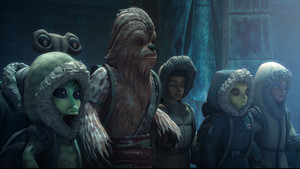 Younglings in the Crystal Cave — The Clone Wars, “The Gathering” · 2012
-
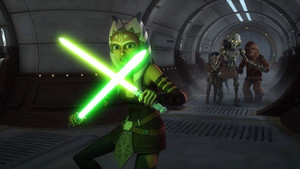 Ahsoka Tano with the younglings and their new lightsabers — “A Test of Strength” · 2012
After the fall of the Jedi Order there was no more Gathering: the survivors built sabers from whatever they could find[2]. The Empire strip-mined Ilum for its crystals, and the First Order later turned the whole planet into Starkiller Base[4].
Kyber: the living crystal
Kyber crystals are rare, Force-attuned crystals that grow on a few worlds across the galaxy — most famously in Ilum's Crystal Cave and on Jedha[3]. They are nearly alive: they “sing” to those they choose and communicate with each other, and they warm only to living things — a sheath or a towel stays cold, a hand does not[3].
They are also enormously powerful. Cut the right way, a large crystal can focus energy into a beam that destroys planets: the Empire looted kyber from Jedi temples, from Ilum and other worlds to build the Death Star's superlaser — the story of Rogue One[3].
Clear
A newly found kyber is clear and colorless. It has not bonded with anyone yet[2].
Bonded
Awakened through the Force, the crystal takes on a color that matches its owner. Blue and green are the usual Jedi colors; Mace Windu's is purple, Rey's yellow[2][3].
Bled
A Sith cannot make a crystal choose them, so they take one from a Jedi and pour the dark side into it until it “bleeds” red. Darth Vader did it to the crystal of Jedi Master Kirak Infil'a — and the crystal fought back with visions[3].
Healed
A bled crystal can be healed. Ahsoka Tano purified the two crystals from the saber of an Inquisitor, the Sixth Brother: they turned white and became her blades[3].
Cracked
Push a crystal too hard and it cracks. Kylo Ren's cracked as he bled it, so his blade is unstable: two side vents dump the excess energy — the reason his lightsaber has a crossguard[2][3].
Some crystals break the pattern. Jedi Masters Ki-Adi-Mundi and Agen Kolar each had a lightsaber that could switch from green to blue[2]. A kohlen crystal gives a weak orange blade — useless in a duel, yet the only thing that slices through shields powered by the same kind of crystal, in the novel Master & Apprentice[2].
Every blade color
In the story the color comes from the crystal[2]. Behind the camera every new color has its own story — and some were decided long after filming had ended[2]. Tap a blade to ignite it: it becomes your crystal everywhere on this page.
-
Obi-Wan Kenobi, Anakin and Luke Skywalker, Leia
In the first two films the Jedi were blue and the Sith red. The props were plain white rods; the colors were painted in, frame by frame, after filming[2].
-
Yoda, Qui-Gon Jinn, Luke in Return of the Jedi
Luke's new saber was blue in early edits, trailers and posters. It turned green to stand out against Tatooine's blue sky — and to show it was a new weapon[2].
-
Mace Windu, Vernestra Rwoh
Samuel L. Jackson asked for purple, his favorite color, so that Mace Windu would stand out among the Jedi of Attack of the Clones[2].
-
The Jedi Temple Guards, Rey
Familiar from animation, yellow made its live-action debut in the last scene of The Rise of Skywalker, with Rey's own saber[2].
-
Darth Vader, Darth Sidious, Maul, Count Dooku
The color of a bled crystal — and of the Sith since 1977[2][3].
-
Ahsoka Tano
The color of a healed crystal: a Sith crystal purified back to the light[3].
-
Baylan Skoll, Shin Hati
Dave Filoni chose it for Ahsoka to show that these dark warriors are not Sith[2].
-
The Darksaber
A flat black blade with a white glow — the only one of its kind (chapter 06)[5].
-
Cyan, indigo, magenta, orange, yellow-green
Seen in High Republic stories and in Star Wars Jedi: Fallen Order; Ahsoka's short saber glowed yellow-green[2][3].
On screen
-
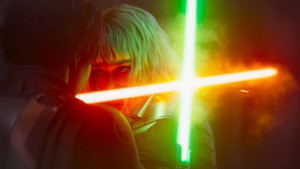 Shin Hati's orange-red blade crosses a green one — Ahsoka, “Fallen Jedi” · 2023
-
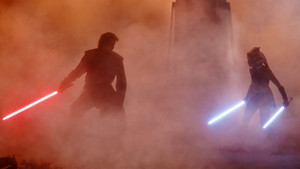 Ahsoka Tano's white blades — Ahsoka, “Shadow Warrior” · 2023
Does the color mean anything? In canon it is not a rank or a job: it reflects the bond between a crystal and its owner[2]. Red is the exception — it is what the dark side does to a crystal.
Not just one blade
Most Jedi carried a classic single blade, but the galaxy is full of variations[2]. Point at a card or tap it to ignite the blade.
-
Single blade
Most Jedi and Sith
The classic: one hilt, one blade, usually held with both hands[2].
-
Double-bladed
Darth Maul · The Phantom Menace (1999)
A blade at each end turns it into a deadly staff. Some fold in half when switched off[2].
-
Curved hilt
Count Dooku · Attack of the Clones (2002)
The curve sits better in the palm for one-handed fencing styles like Makashi[2].
-
Shoto
Yoda; Ahsoka Tano's second blade
A short blade — usually the second weapon in two-blade fighting[2].
-
Crossguard
Kylo Ren · The Force Awakens (2015)
Two short side blades vent the energy of a cracked crystal. The design itself is ancient: it goes back to the Great Scourge of Malachor[2].
-
Spinning double blade
The Inquisitors · Star Wars Rebels (2014)
A ring-shaped hilt whose two blades spin around it along a track[2].
-
Lightsaber pike
Jedi Temple Guards · The Clone Wars
A staff with a yellow blade at each end, carried by the masked guards of the Jedi Temple[2].
-
Lightwhip
Vernestra Rwoh · The Acolyte (2024)
A thin flexible blade several meters long that can entangle an opponent. Vernestra's saber switches to it with a twist of a ring[6].
-
Darksaber
Tarre Vizsla · The Clone Wars (2010)
Black, flat and pointed like a real sword. Made around 1050 BBY by Tarre Vizsla, the first Mandalorian Jedi; it can't be given, only won in combat. Moff Gideon crushed it in The Mandalorian season 3[5].
-
Split saber
Cal Kestis · Star Wars Jedi: Fallen Order (2019)
Two lightsabers that lock together into one double blade — and come apart again[2].
-
Blaster-saber
Ezra Bridger · Star Wars Rebels (2014)
A lightsaber with a blaster built into the hilt[2].
-
Training saber
Younglings with Yoda · Attack of the Clones (2002)
Locked on a permanent low-power setting — safe enough to teach initiates how to fight[2].
Training with a remote
Aboard the Millennium Falcon, Obi-Wan Kenobi gives Luke a lightsaber and sets a floating training remote on him — then pulls a helmet's blast shield down over his eyes. Turning blaster bolts aside is exactly what Form III, Soresu, was made for[7]. Your turn.
Your eyes can deceive you. Don't trust them.
The training game needs JavaScript.
With the blast shield down, turn the sound on: the remote's hum moves left and right with it, and every shot gives itself away a split second early.
What a blade can't cut
A lightsaber cauterizes as it cuts, so even a severed limb hardly bleeds[2]. It turns blaster bolts aside and melts its way through blast doors. But a few things stand up to it[2]. Pick a target and strike.
- Blast door. Melts through — slowly. Qui-Gon Jinn burns a glowing hole into a blast door in The Phantom Menace.
- Blaster bolt. Deflected. Using the Force to sense the shot, a Jedi sends it straight back[1].
- Another lightsaber. Clash. Two blades don't cut each other — they lock and spit sparks.
- Beskar. Holds. Pure Mandalorian beskar resists a blade for a while: Din Djarin's armor stood up to Ahsoka Tano's sabers[2].
- Cortosis. Switches it off. Cortosis armor drains the blade's energy and shuts it down for a moment[2].
Movie magic
In 1977 a lightsaber was a camera flash. Prop maker Roger Christian found old Graflex flash handles in a London photography shop and dressed them with cabinet T-track and odds and ends; George Lucas asked for a belt clip[8]. Darth Vader's hilt was a Micro Precision Products flash. Obi-Wan's was the most complex: a tap handwheel, a machine-gun booster, a First World War rifle grenade and a part of a Rolls-Royce jet engine[2].

The blades were harder. On set they were three-sided rods covered in reflective Scotchlite, spun by a small motor in the hilt to catch the light — fragile, and invisible whenever they turned away from the camera[2][8]. So every blade was traced by hand, frame by frame. Animator Nelson Shin drew them in about a week; he suggested making them look “a little shaky”, like a fluorescent tube, with one extra-bright frame to make the light vibrate[8].
Later films changed the recipe: carbon rods for The Empire Strikes Back and Return of the Jedi, then steel and aluminium rods for the prequels[2].
That sound
The hum came from sound designer Ben Burtt. He mixed the idling hum of the interlocking motors of old cinema projectors with a buzz a TV set put into a microphone cable that had no shielding — found by accident, while he was looking for a sparking sound[8]. For the swing he played the hum through a speaker and waved a microphone past it: the Doppler effect bends the pitch[8].
Our synthesizer follows the recipe; it is not the original recording.
The sound lab needs JavaScript.
Nelson Shin added one more idea: the sound of a degausser, because a lightsaber should feel like a magnetic field[2].
Could we build one?
Not the way the films show it — at least not yet. A laser won't do: a beam of light doesn't stop after a meter, it travels until something absorbs it, and two beams pass straight through each other instead of clashing[9].
Plasma — gas so hot its atoms lose their electrons — comes closer: it glows, and it cuts. But it wants to spread out. Magnets can hold it, but only inside a container, and a sword can't have one[10]. Fuel is the other problem: there is nothing in a hilt to keep it burning for a whole duel[9].
In 2020 the engineers behind the YouTube channel The Hacksmith built the first retractable plasma lightsaber. Propane and oxygen burn in a carefully shaped, smooth “laminar” jet at about 2,200 °C (4,000 °F) — above the melting point of most metals[10][11]. The catch: it is tethered to a backpack of gas.
Quick answers
Can a lightsaber change color?
Yes, if its crystal changes. Bleeding a crystal with the dark side turns it red; healing a bled crystal turns it white, as Ahsoka Tano did[3].
Why are Sith lightsabers red?
A kyber crystal won't choose a Sith, so the Sith take crystals from Jedi and “bleed” them with the dark side until they turn red[2][3].
What is a kyber crystal?
A rare, Force-attuned crystal at the heart of every lightsaber: it focuses the energy and gives the blade its color. Kyber also powered the Death Star's superlaser[3].
How does a Jedi get a crystal?
Traditionally in the Gathering: younglings travel to the Crystal Cave on Ilum and find the crystal that calls to them[3][4].
What is the Darksaber?
An ancient black-bladed lightsaber made by Tarre Vizsla, the first Mandalorian Jedi, around 1050 BBY. It has to be won in combat; Moff Gideon destroyed it in The Mandalorian season 3[5].
Who has a purple lightsaber?
Mace Windu — at Samuel L. Jackson's request — and, in the High Republic era, Vernestra Rwoh[2].
What can't a lightsaber cut?
Another lightsaber, beskar, cortosis, armorweave, phrik and the armor of the Praetorian Guards[2].
Sources
- StarWars.com Databank — “Lightsaber” (diagram from Star Wars: The Visual Encyclopedia)
- Wookieepedia — “Lightsaber”
- Wookieepedia — “Kyber crystal”
- Wookieepedia — “Ilum”
- Wookieepedia — “Darksaber”
- Wookieepedia — “Lightwhip”
- Wookieepedia — “Lightsaber combat”
- Wikipedia — “Lightsaber”: props, visual effects and sound design
- ScienceAlert — “Could We Ever Make a Real Lightsaber?” (2022)
- The Hacksmith — “Retractable Plasma Lightsaber”, DigiKey Maker.io (2020)
- Guinness World Records — Hacksmith creates world’s first retractable lightsaber (2020)
- Wikipedia — “Flame test”
Now watch them in action
Every film, series and game on one timeline, in the order the story happens — with checkmarks for what you've seen.